
Mar 24
2026
AI Agents in Business Central: Redefining ERP Automation
Today’s ERP systems are more than just a back-end technology. They're evolving to be intelligent and autonomous. They will act, learn and optimize continuously. With the power of AI Agents in Microsoft Dynamics 365 Business Central, businesses will move away from rule-based processes and towards a self-operating ERP system.
These AI Agents enable real-time decision support, automate financial and operational workflows and identify risks early. With Microsoft Dynamics 365 Business Central, businesses can improve accuracy, reduce manual effort and scale operations confidently in a data-driven environment.What Are AI Agents in Business Central?
AI Agents in Business Central are autonomous digital operators. They will constantly observe the system’s data, identify opportunities and risks and take context-aware decisions to act on them.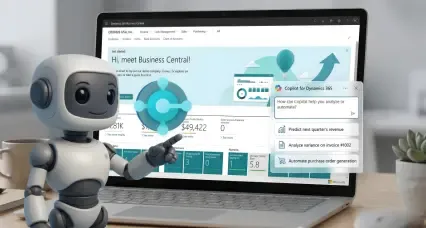.png)
Key Capabilities
- Continuously monitor operations & finances in real time
- Identify & manage risks including fraud, liquidity & stockouts
- Make contextual decisions using predictive analytics or business rules
- Take action automatically based on these decisions.
What Are the Essential Functions of AI Agents?
- Financial Intelligence - automatic reconciliation, detect anomalies, predict cash forecasts and detect fraud
- Supply Chain Optimization - dynamic ordering, risk score suppliers, intelligently route disruption cases in the supply chain
- Sales & Customer Experience - predict leads, offer personalized offers and deliver orders quickly
- Governance & Compliance - continuous monitoring; provide automated audit trails; enforce policies
What Are AI Agents in Business Central? How Do They Differ from Traditional ERP System Automation?
Decision ModelThe traditional ERP system follows a rule-based system. However, the AI Agents will use adaptive intelligence to act on the context.
Human Intervention
Traditional automation involves human intervention. AI Agents do not require human intervention. They update themselves and make changes to the process in real time based on data and trends.
Learning
Traditional automation is static. AI Agents learn and update themselves continuously. This improves their accuracy over time.
Compliance & Risk
In traditional automation, periodic checks are made to ensure compliance. AI Agents continuously monitor and ensure compliance. This is done in real time, and no risk is involved.
.png)
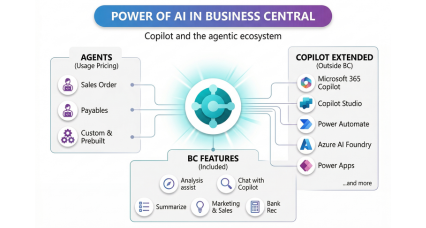
Copilot vs. AI Agents
- Copilot = Human-assisted intelligence that provides guidance, suggestions and conversations with the end users.
- AI Agents = Autonomous operators that execute tasks and make decisions without human involvement.
Benefits of the Hybrid Solution
By combining Copilot and AI Agents, we have a powerful solution. Copilot will provide end users with information and help interpret complex situations. AI Agents will then act on this information to execute tasks. This will provide end users with the benefits of human judgment and the benefits of hands-free operation. This is the added value provided by the Copilot-AI Agents hybrid solution. This is the added value provided by the Copilot-AI Agents solution.
Real World Use Cases
- Finance Teams - AI Agents will be used to reconcile accounts, detect suspicious transactions and reduce month-end close time.
- Supply Chain Leaders - AI Agents will be used to route orders around supplier delays and optimize safety stock levels dynamically.
- Small and Medium Businesses - Enterprise-class automation without requiring large teams to achieve this. This will allow small and medium businesses to grow faster with lower costs.
- Executives - Real-time dashboards powered by AI Agents to make faster and better decisions based on the insights provided by AI Agents.
Implementation Roadmap
- Identify high-impact processes to be automated, including accounts payable, inventory replenishment and order exceptions.
- Integrate with predictive analytics to enable smarter and context-based decisions.
- Cross-departmental automation flows to enable the agents to function across finance, procurement and sales.
- Continuous refinement using outcome measures and real-time feedback loops to enhance accuracy and efficiency.
Why AI Agents Are the Future of ERP
The concept of AI Agents heralds a new paradigm in the management and operation of ERP.This is because the technology offers the following advantages:
- They function independently to minimize the workload on employees.
- They continuously improve and adapt to new information.
- They expand without a linear increase in cost by automatically processing tasks, both simple and complex.
Conclusion
The concept of AI Agents is a new and distinct entity in the management and usage of ERP. By introducing intelligence and autonomy in the management and usage of Business Central, businesses and organizations will be able to create a self-operating ERP system.Ray Business Technologies specializes in providing Microsoft-centric ERP solutions, secure and scalable ERP implementation, and migrating to ERP in the USA and Australia. Schedule your free assessment today and let us explore the possibilities of creating autonomous ERP using AI Agents.
